Most of what separates one roulette table from another fits on a single line of maths. Count the pockets, look at what happens to an even-money bet when zero comes up, and check what a straight-up pays. Those three facts decide the price of the game. Everything else on a variant’s menu card, from the camera work to the name of the dealer’s lounge, is presentation.
That is good news for anyone choosing a table, because it means you can compare variants on paper before you sit down. This page lines up the five types you will meet in Canada, online and in person, and points to a deeper guide for each.
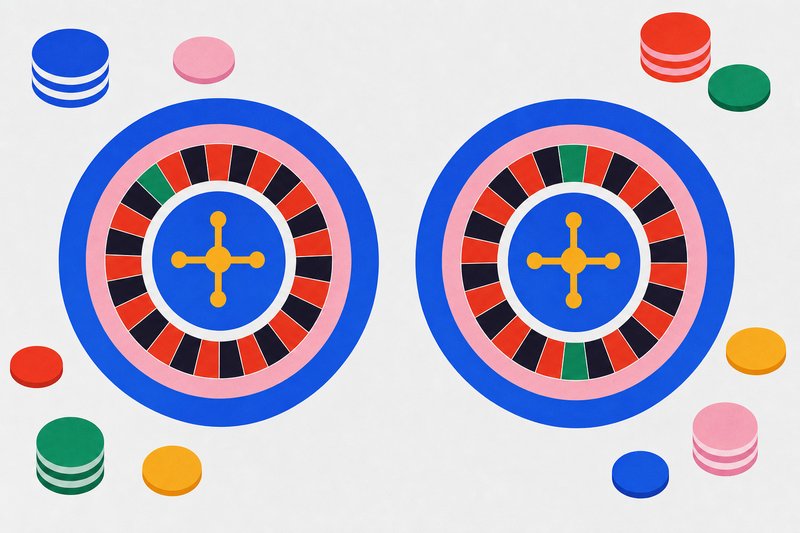
The five roulette variants at a glance
The table below compares them on the points that change your money: the wheel, the number of pockets, the house edge, the rule that makes the variant different, and how quickly rounds come around.
| Variant | Wheel | Pockets | House edge | Special rules | Pace |
|---|---|---|---|---|---|
| European | Single zero | 37 | 2.70 % on every bet | None; often a racetrack on live tables | Standard live round |
| American | 0 and 00 | 38 | 5.26 %; 7.89 % on the five-number bet | Five-number bet on 0, 00, 1, 2, 3 | Standard live round |
| French | Single zero | 37 | 1.35 % on even money, 2.70 % otherwise | La Partage or En Prison, racetrack call bets | Standard live round |
| Multiplier | Mostly single zero | 37 on the titles we checked | Mostly unpublished; Mega Roulette 3000 states a 97.50 % RTP | Reduced straight-up payout, random multipliers | Each round adds a multiplier draw before the result |
| Auto | European, French or American | 37 or 38 | Same as the matching wheel | No dealer; machine-launched ball | 60 to 80 rounds an hour (Evolution) |
If you take one thing from the table, take the edge column. A single-zero wheel costs about half what a double-zero wheel costs for the same stakes, and French rules halve the cost again on even-money bets. Nothing a dealer or a studio does on top of that changes the order.
Why the zero pockets decide the price
A roulette wheel pays as though the zero pockets were not there. A straight-up pays 35 to 1, which would be a fair price on a wheel of 36 numbers. Add one green pocket and the bet wins 1 time in 37; add a second and it wins 1 time in 38.
The working is short. On a European wheel, a C$1 straight-up wins C$35 once in 37 spins on average and loses C$1 the other 36 times, a net of minus C$1 over 37 spins: an edge of 1/37, or 2.70 %. On an American wheel the same bet nets minus C$2 over 38 spins: 2/38, or 5.26 %. Our house edge guide runs the same sum for every bet on the layout, and the odds and payouts table lists each payout.
The payouts do not move between variants, apart from a few side bets. Split pays 17 to 1, street 11 to 1, corner 8 to 1, six line 5 to 1, dozen and column 2 to 1 and the even-money bets 1 to 1 on European, French and American tables alike. The pocket count is the only thing that differs, and it applies to every bet at once.
European roulette: the baseline
The European wheel has 37 pockets, numbered 1 to 36 plus a single green zero, in an order that alternates red and black and spreads high and low numbers around the rim. That fixed order matters for call bets, which we cover in the French guide.
At 2.70 % on every bet, European roulette is the yardstick the other variants are measured against. It is also the default in most online lobbies: Evolution, Pragmatic Play Live and Playtech Live all run single-zero tables, and the bulk of their multiplier titles are built on the same wheel. Our European roulette guide goes through the wheel order, the bets and the tables you will see under that name.
American roulette: one extra pocket, double the cost
The American wheel adds a 00 pocket, for 38 in total, and its numbers run in a different order from the European wheel. The extra pocket roughly doubles the house edge to 5.26 %, and the layout carries one bet with an even worse price: the five-number bet on 0, 00, 1, 2 and 3, which pays 6 to 1 and carries a 7.89 % edge.
Plainly put, there is no reason to choose a double-zero table when a single-zero one is open at the same stakes. You get the same payouts and lose money twice as fast on average. Double-zero tables still exist because some players want the American layout they know, and some land-based floors keep them. The American roulette guide shows the five-number sum in full.
French roulette: the cheapest even-money bets
French roulette uses the European wheel but changes what happens to even-money bets when the ball lands on zero. Under La Partage, half of the stake comes back. Under En Prison, the stake stays on the table for one more spin and is returned if it wins.
For a C$10 bet on red, La Partage means a zero costs C$5 instead of C$10. The edge on even-money bets falls to 1/74, or 1.35 %, which is the lowest price on any standard roulette bet. Inside bets do not get the same treatment, so a straight-up at a French table still costs 2.70 %. The French layout also brings the racetrack and its call bets, explained number by number in our French roulette guide.
A quick side note on names. Some lobbies label a table “French” because of the layout or the language at the table, without La Partage or En Prison. Read the rules panel before assuming the lower edge applies.
Multiplier roulette: same wheel, reshuffled payouts
Lightning-style roulette keeps the wheel and changes the payout table. Before each spin, the game picks a few numbers and gives them a multiplier. If one of those numbers wins and you have a straight-up on it, the multiplier applies. To pay for this, the base straight-up payout drops below 35 to 1.
Evolution’s own page for Lightning Roulette sets out the shape: 1 to 5 Lucky Numbers per round with multipliers from 50x to 500x, and 29:1 on a straight-up that wins without one. Pragmatic Play’s Mega Roulette and Playtech’s Quantum Roulette work along similar lines. What the game pages do not publish is how often each multiplier comes up, so the true edge on a straight-up is not something we can check. The multiplier roulette guide works through what 29:1 means on its own and where the outside bets stand.
Auto roulette: no dealer, more rounds
Auto roulette is a real wheel with a mechanical launcher instead of a croupier. Evolution runs European, French and American versions, and its game page states 60 to 80 rounds an hour, all day and night. The edge is whatever the wheel type sets; the unbroken rhythm, day and night, is the real difference.
More rounds per hour means more money wagered per hour at the same stake, and so a higher average cost per hour. That catches people out, because an auto table never pauses. At C$5 on red, 70 spins of European auto roulette put C$350 on the table in an hour, and the long-run cost is 2.70 % of that, C$9.46. The auto roulette guide works out that hourly figure for all three wheels.
Where each variant turns up: online and on a casino floor
Online lobbies carry the widest spread. A lobby registered with iGaming Ontario usually shows several European tables, at least one American table, French-style tables with the racetrack, a handful of multiplier games and auto wheels running in the background. Digital RNG versions of the same variants sit alongside the live studio tables; our page on RNG and live dealer roulette explains how the two differ.
Casino floors in Canada are a different picture. Each venue decides which wheels to install, and most venue pages never say whether a wheel has one zero or two. The ones that do are useful: Fallsview Casino Resort names European single-zero roulette in its high-limit room, while Casino Rama lists an automated Double 00 game. Several venues also state electronic or automated roulette next to the dealer-run tables, while none of the venue pages we read mentions La Partage or En Prison. We list what each venue publishes about its tables on our land-based casinos page, and we leave a venue’s row blank where it says nothing.
So which should you pick? For a dealer-run table online, a European or French table at a stake you are comfortable with. Our live roulette guide compares the studios and the table limits in C$, and the Ontario page narrows that down to casinos registered in the province. On a casino floor, ask for the single-zero table; if the venue only runs double zero, factor in the higher cost before you sit down.
One evening on three wheels, in numbers
Prices per spin are easy to compare and easy to forget, so here is the same evening played three ways: 200 spins of C$10 on red, C$2,000 wagered across the night.
At a European table the long-run average cost of that evening is C$2,000 ÷ 37, about C$54.05. At an American table it is C$2,000 × 2 ÷ 38, about C$105.26. At a French table with La Partage it is C$2,000 ÷ 74, about C$27.03. Bets, dealer and evening are identical; the bill differs by a factor of almost four between the cheapest wheel and the dearest.
None of those figures is what will happen on a given night. With 200 even-money bets the result swings by far more than the average cost, in either direction. The average is what you pay across many evenings, and it is the only part of the result your choice of table controls.
Digital and live versions of the same variant
Every variant on this page exists in two forms online. Live tables stream a physical wheel from a studio. Digital versions draw the result from a certified random number generator and show an animated wheel. A digital European table has the same rules and payouts as a live European table, so it has the same edge.
Control over pace is the real difference. A digital table spins when you press the button, so you set the speed, fast or slow. A live table runs on the studio’s clock and its betting countdown. Players who want a slow, steady game often find the live table easier to pace, because the gap between rounds is built in.
Before you choose a table
Three checks are worth thirty seconds each. Look at the wheel in the stream or the table graphic and count the green pockets. Open the rules panel and look for La Partage or En Prison if you plan to bet on colours. Check what a straight-up pays: if the figure is not 35 to 1, you are at a multiplier table, whatever the name says.
Then decide how long you are playing for. Pace and stake together set the hourly cost, and setting a time limit is as useful as setting a money limit. Our responsible gambling page lists the tools and help lines in each province, and if you want to try the bets first, the practice wheel uses play chips on a single-zero wheel.
One piece of history explains why two wheels survive. The single-zero wheel is usually traced to François and Louis Blanc, who ran it at Bad Homburg in 1843 as a cheaper game than the double-zero wheels of the day; François Blanc later took it to Monte Carlo. American tables kept both zeros, and that gap in price has outlasted almost every other rule change since.