Put a C$10 chip on 17. If the ball drops there, the dealer pushes C$350 across the felt and leaves your C$10 where it was. If it drops anywhere else, the chip is gone. Every bet on the layout works on that same pattern, and the roulette payout chart below lists all of them: how many numbers each bet covers, what it pays, how often it wins and how much of each dollar the wheel keeps over time.
The figures are exact. A European wheel has 37 pockets (1 to 36 plus a single zero); an American wheel has 38 (an extra double zero). Nothing about roulette odds needs to be taken on trust, because every number on this page can be worked out with a pencil.
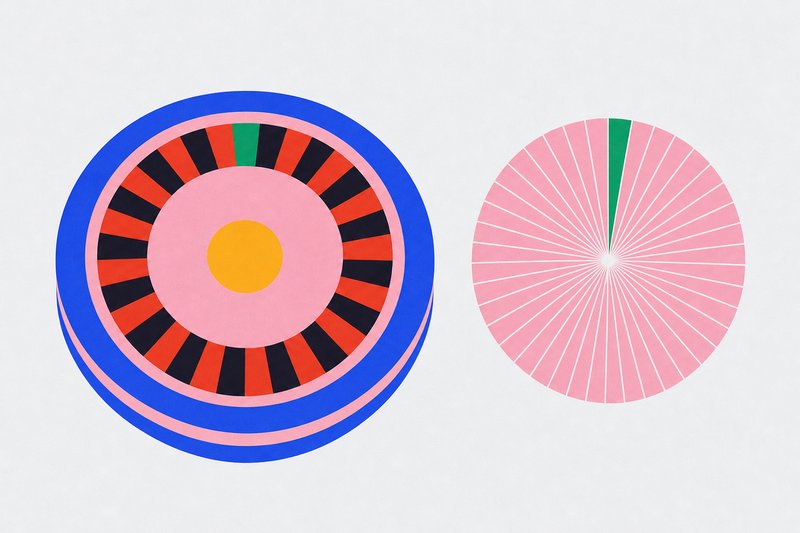
The full roulette payout chart, bet by bet
| Bet | Numbers covered | Pays | Chance per spin, European (37) | Chance per spin, American (38) | House edge, European | House edge, American | More detail |
|---|---|---|---|---|---|---|---|
| Straight up | 1 | 35 to 1 | 2.70 % (1 in 37) | 2.63 % (1 in 38) | 2.70 % | 5.26 % | |
| |||||||
| Split | 2 | 17 to 1 | 5.41 % | 5.26 % | 2.70 % | 5.26 % | |
| |||||||
| Street | 3 | 11 to 1 | 8.11 % | 7.89 % | 2.70 % | 5.26 % | |
| |||||||
| Corner | 4 | 8 to 1 | 10.81 % | 10.53 % | 2.70 % | 5.26 % | |
| |||||||
| Five-number (0, 00, 1, 2, 3) | 5 | 6 to 1 | not offered | 13.16 % | n/a | 7.89 % | |
| |||||||
| Six line | 6 | 5 to 1 | 16.22 % | 15.79 % | 2.70 % | 5.26 % | |
| |||||||
| Dozen or column | 12 | 2 to 1 | 32.43 % | 31.58 % | 2.70 % | 5.26 % | |
| |||||||
| Red/black, odd/even, 1 to 18, 19 to 36 | 18 | 1 to 1 | 48.65 % | 47.37 % | 2.70 % | 5.26 % | |
| |||||||
Two columns matter most. “Pays” tells you what a win is worth, and “House edge” tells you what the game costs. Notice that the edge column barely moves: on a European wheel it reads 2.70 % from top to bottom. That is the single most useful fact about roulette payouts, and most of this page explains why it holds. If you want the roulette payout chart on its own for the fridge or a notebook, the printable payout chart has a clean version with nothing else on the page.
Odds against and the payout are two different numbers
Most confusion about roulette odds starts here. The odds against a straight-up win on a European wheel are 36 to 1: there are 36 losing pockets for every winning one. The payout is 35 to 1. That one-unit gap between the true odds and what the table pays is where the casino earns its living.
The same gap shows up on every bet. A split has 35 losing pockets against 2 winning ones, which is 17.5 to 1 against; it pays 17 to 1. A dozen has 25 losers against 12 winners, odds of about 2.08 to 1 against; it pays 2 to 1. Each time, the casino pays a little less than the true odds, and each time the shortfall works out to the same share of the stake.
On an American wheel the true odds against a straight-up are 37 to 1, but the payout is still 35 to 1. The gap is two units, not one. Same chips, same layout, twice the cost.
Where the payouts come from: 36 divided by the numbers covered
Every standard payout on the table follows one rule. Take 36, divide it by the number of pockets the bet covers, and subtract 1:
- Straight up: 36 ÷ 1 − 1 = 35
- Split: 36 ÷ 2 − 1 = 17
- Street: 36 ÷ 3 − 1 = 11
- Corner: 36 ÷ 4 − 1 = 8
- Six line: 36 ÷ 6 − 1 = 5
- Dozen or column: 36 ÷ 12 − 1 = 2
- Even money: 36 ÷ 18 − 1 = 1
The “minus 1” is there because roulette quotes winnings separately from the stake you get back. A winning dozen bet of C$1 returns C$3 in total: C$2 of winnings and your own C$1.
Why 36 and not 37? Because a fair game on a 37-pocket wheel would use 37. If a straight-up paid 36 to 1, a player betting every number once would get back exactly what went in, on average. The table uses 36, so the return on any bet is 36/37 of the stake over the long run. The missing 1/37 is the house edge, 2.70 %.
You can check this with any bet. Put C$1 on a corner: it wins 4 times in 37 and returns C$9 each time, so 37 spins return 4 × C$9 = C$36 on C$37 staked. Put C$1 on red: 18 wins in 37 return C$2 each, again C$36 on C$37. The arithmetic comes out the same because the payouts were built that way.
There is a stray bit of roulette trivia hiding in those 36 numbers. Add up 1 + 2 + 3 all the way to 36 and you get 666, and that total is where the game’s old nickname comes from: “the devil’s wheel”, coined long before anyone worked out house edges on a calculator. The total has no effect on anything at the table.
Why the zero is the whole edge
Take the zero off a European wheel and roulette becomes a fair game: 36 pockets, payouts of 36 ÷ n − 1, an average return of exactly 100 %. The green pocket is the casino’s entire margin.
Here is how it bites on the outside bets. Red covers 18 numbers and black covers 18. Neither covers zero. When the ball lands on 0, every even-money bet, every dozen and every column loses at once, and the payouts on those bets were never set high enough to make up for that one extra losing pocket.
On the inside bets the zero works more quietly. You can bet on it directly at 35 to 1, so it does not wreck a straight-up player in the same visible way. But it is still a 37th pocket that the 35 to 1 payout ignores, and the maths lands in the same place: 2.70 %.
The American wheel adds 00 and the problem doubles. Two green pockets, 38 in total, the same payouts. The return on a dollar becomes 36/38, so the edge is 2/38, or 5.26 %. Our house edge guide goes through both wheels and the French rules side by side, with the edge expressed per C$1,000 wagered. If you have a choice between a single-zero and a double-zero table, take the single zero. There is no situation where the American wheel gives the player better value.
The one bet with worse odds: the five-number line
American layouts carry one bet that breaks the pattern. The five-number bet, sometimes called the top line or the basket, covers 0, 00, 1, 2 and 3 and pays 6 to 1.
Run it through the formula and the problem is obvious: 36 ÷ 5 − 1 = 6.2. A payout of 6.2 to 1 is impossible to pay in chips, so the casino rounds down to 6. Over 38 spins the bet wins 5 times and returns 5 × C$7 = C$35 on C$38 staked. The house keeps C$3 in 38, an edge of 7.89 %, half as bad again as every other bet on the same table.
A single-zero wheel has no equivalent. The nearest thing on a European layout is the “first four” corner covering 0, 1, 2 and 3, which pays the normal corner rate of 8 to 1 at the normal 2.70 %.
French rules halve the even-money edge
Some single-zero tables add a rule for the even-money bets when zero comes up. Under La Partage you lose only half your stake. Under En Prison the stake stays on the table for the next spin: if it then wins, you get it back without winnings; if it loses, it is gone.
Under La Partage, a C$1 even-money bet loses C$0.50 on zero instead of C$1. The house edge becomes half of 1/37, which is 1/74, or 1.35 %. En Prison gives the same 1.35 % on tables where a second zero simply keeps the bet imprisoned. Neither rule touches inside bets, dozens or columns: those stay at 2.70 %.
A 1.35 % even-money bet is the cheapest bet in roulette. If you mostly play red/black, a French table is worth looking for. Our French roulette guide covers which games carry the rule.
What the house edge costs over a session
The edge only turns into dollars once you count the total you wager, every chip on every spin. The formula is short: total wagered × house edge = average cost.
A hundred spins at C$5 is C$500 wagered. On a European wheel 2.70 % of C$500 is about C$13.51. On an American wheel 5.26 % of the same C$500 is about C$26.32. Those are averages over a very long run; any single session will land somewhere around them, sometimes well ahead and sometimes well behind. The calculator on our homepage runs this for any bet, stake and number of spins, and shows the chance per spin next to the average cost.
Pace matters as much as the edge. A live table that spins every 25 seconds, such as Evolution’s Speed Roulette, fits roughly twice as many rounds into an hour as a standard table, so the same edge costs about twice as much per hour. If you set a budget for a session, set it in time as well as in dollars. Our responsible gambling page lists the limit tools and the support lines by province.
Same edge, very different rides
If every bet costs 2.70 %, why does the choice of bet matter at all? Because the swings are completely different.
On a straight-up bet you lose most spins. Over 37 spins on one number there is about a 36 % chance that the number never comes up at all, and over 100 spins there is still a 6.5 % chance of no hit. When it does hit, one win can cover 35 losing spins. On red you win nearly half the time and lose nearly half the time, and your balance drifts slowly.
Statisticians measure this with the standard deviation per unit bet: about 5.84 for a straight-up, 1.40 for a dozen and 1.00 for an even-money bet on a European wheel. Same average loss, very different distance from it. Our article on inside and outside bets turns those figures into what they mean at the table.
Multiplier tables change the payouts, not the arithmetic
Live games like Lightning Roulette, Mega Roulette and Fireball Roulette add random multipliers to straight-up numbers. To pay for those multipliers, they usually pay less than 35 to 1 on a plain straight-up win. The 36 ÷ n formula no longer describes the inside bets, so the edge has to be read from the provider’s published return.
Most live roulette providers never print it. Pragmatic Play is an exception on one title: it states a 97.50 % RTP for Mega Roulette 3000, which works out to a 2.50 % edge on that game. For the rest, read the payout table in the game itself before you bet. Our guide to multiplier roulette explains how these payouts are rebuilt.
Odds online, at a live table and at a land-based wheel
A standard European game has the same roulette odds wherever you play it. A random number generator in an online game picks from 37 equally likely outcomes; a physical wheel in a studio or a casino lands in one of 37 pockets that are meant to be equally likely. How that is checked, from lab certification to wheel maintenance, is covered in how roulette fairness is tested.
What does change between venues is which wheel you can find. Online, single-zero games are easy to come by. In Ontario’s land-based casinos, Fallsview Casino Resort lists European single-zero roulette in its Privé high-limit area, while Casino Rama lists a double-zero automated game. If you play online in Ontario, our Ontario roulette guide shows which registered casinos carry single-zero tables.
Every guide in this section
- Roulette house edge: single zero, double zero and the French rules, derived step by step.
- Inside vs outside bets: how each bet type behaves over a session.
- Printable roulette payout chart: the bet table on its own, ready to print.
- Is roulette rigged?: how labs test online games and how casinos look after physical wheels.
One small detail to finish on, because it trips up new players at real tables: a chip that wins stays on the layout. The dealer places your winnings beside it, and if you leave everything there, the whole stack rides on the next spin.