The dealer slides a stack of pink chips across the felt, each one worth C$1, and nods at the layout. A few players are already reaching over the numbers. The ball goes into the wheel, starts its loop around the rim, and you have perhaps fifteen seconds to decide where your first chip goes. The roulette rules are simple enough to learn in that time, but almost nobody tells new players the order things happen in, which is where most first-round confusion comes from.
This guide walks through how to play roulette as a sequence: what happens before the spin, during it and after it, then the bets, the wheels and the habits worth having from the start.
What is roulette, before the first chip goes down
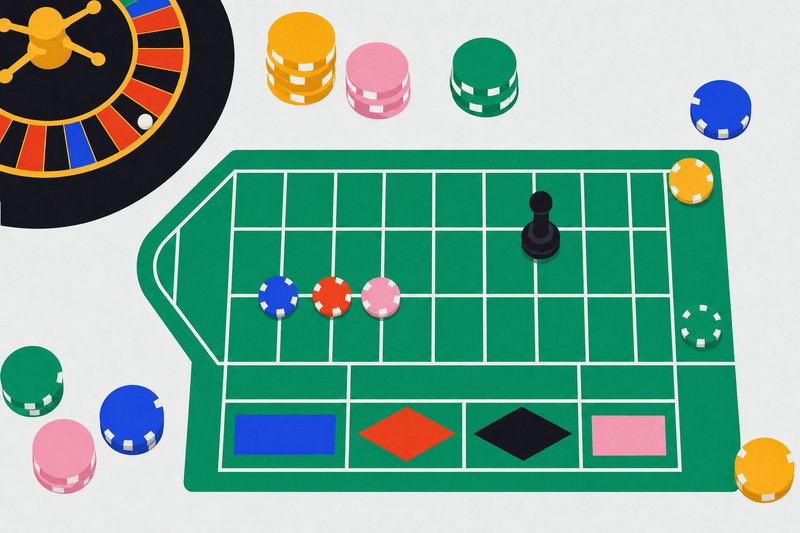
What is roulette in one breath? A ball, a spinning wheel of numbered pockets, and a table where you bet on which pocket the ball will settle in. A European wheel has 37 pockets: numbers 1 to 36, half red and half black, plus a single green zero. An American wheel has 38, adding a green double zero. Everything you can bet on is printed on the table layout beside the wheel.
The name is French for “little wheel”. A popular story names the mathematician Blaise Pascal as its inventor, saying he hit on it in the 17th century while trying to build a perpetual motion machine. Historians treat that as legend, and the game as we know it took shape in French gambling houses in the late 1700s. It is a nice story for the bar afterwards, and it has no bearing on anything at the table.
The roulette rules of a single round
Every round follows the same five steps, at a casino or online.
1. Bets go down. Place chips on the layout: on a number, on the line between numbers, or in one of the outside boxes such as red, odd or a dozen. You can place as many bets as the table limits allow.
2. The dealer spins. The wheel turns one way and the ball is launched the other way around the rim. Betting usually stays open while the ball circles.
3. “No more bets.” As the ball slows, the dealer calls it and passes a hand over the layout. From that moment, nothing goes on and nothing comes off. Online games show a countdown that closes betting before the spin.
4. The ball lands. It drops off the rim, bounces through the pocket separators and settles. The dealer announces the number and colour, for example “17, black”, and places a marker on that number.
5. Settling up. Losing chips are swept away first. Winning bets are paid, with the winnings placed next to your original chip, which stays where it is. When the marker comes off, the next round begins.
That is the whole game. Every spin is independent: the wheel has no memory, and a number that has not appeared for a while is no more likely to appear next.
Bets and what they pay
Bets split into two groups. Inside bets go on the numbered grid and cover one to six numbers: a straight-up on one number pays 35 to 1, a split on two pays 17 to 1, a street of three pays 11 to 1, a corner of four pays 8 to 1, and a six line pays 5 to 1. Outside bets sit in the boxes around the grid: a dozen or a column pays 2 to 1, and red/black, odd/even, 1 to 18 and 19 to 36 pay 1 to 1.
The bigger the payout, the fewer numbers the bet covers, so it wins less often. On a single-zero wheel the casino’s edge is 2.70 % on every one of those bets, whatever the payout. The roulette odds and payouts page has the full table, and the inside vs outside bets guide explains why the choice changes how a session feels without changing what it costs.
Chips: buying in at a casino table
At a land-based table you buy in by placing cash on the felt between bets. The dealer counts it out on the felt and gives you a stack of roulette chips in a colour no one else at the table is using. These coloured “wheel chips” have no value printed on them. The dealer marks the value you chose, often with a button on the chip rack, so the table knows whose chips are whose.
Wheel chips belong to that table only. When you leave, colour up: hand your stack back to the dealer, who changes it into regular casino chips that you can cash at the cage. Our article on roulette etiquette at a Canadian casino table covers buying in, tipping customs and the small courtesies dealers appreciate.
Online the money side is simpler: your balance shows on screen and you pick a chip value before clicking on the layout.
The wheel and the layout
The numbers on the wheel are not in order. On a European wheel, 0 sits between 32 and 26, and the sequence runs 32, 15, 19, 4, 21, 2, 25 and so on, arranged so that reds and blacks alternate and highs and lows are mixed. The layout, by contrast, puts 1 to 36 in a neat grid of three columns and twelve rows, with zero at the head.
That difference matters only for call bets on European tables, which cover sections of the wheel. For everything else, you read the layout. Our guide to the roulette table layout shows the European and American grids side by side and marks where every bet sits.
A first-session plan for beginners
Here is a sensible way for beginners to approach a first session, whether online or at a casino:
- Pick a single-zero table. European or French roulette has a 2.70 % house edge; American roulette, with its double zero, has 5.26 %. Same payouts, roughly double the cost.
- Set the budget and the time first. Decide what the session may cost and how long it will last before you buy in. If the budget runs out, the session is over.
- Start outside. Red/black or a dozen wins often and swings gently, so a small budget lasts long enough to get comfortable with the pace.
- Add inside bets later. Once the rhythm of rounds feels natural, try a corner or a straight-up and watch how differently the balance moves.
One plain judgement worth taking to the table: the choice of wheel is the only decision that changes what roulette costs you. Everything else changes how the results are spread.
European, American and French rules
The three main versions share the same layout logic and the same payouts. What changes is the wheel and one rule.
European roulette uses the 37-pocket wheel with a single zero. It is the version you will find most often online.
American roulette adds 00 and the five-number bet (0, 00, 1, 2, 3 at 6 to 1), which carries the worst edge on the table at 7.89 %.
French roulette uses the single-zero wheel, French labels on the layout and, usually, La Partage: when zero comes up, even-money bets lose only half their stake. That brings the edge on those bets down to 1.35 %.
Our house edge guide works out all three, and the variants section covers European roulette and American roulette in detail.
A worked first round
The quickest way to learn how to play roulette is to follow one round with real numbers. Say you buy in for C$50 at a single-zero table with a C$1 minimum per number and C$5 per outside bet, and you take C$1 chips. Before the first spin you put five chips on red, one chip straight up on 17 and one on the corner of 25, 26, 28 and 29. That is C$7 on the layout.
The ball lands on 26, black. Red loses its five chips. The straight-up on 17 loses. The corner covers 26, so it pays 8 to 1: the dealer puts eight chips next to your one, and the original stays. You are down C$6 on the bets that lost and up C$8 on the corner, so your stack has gone from C$50 to C$52 after one spin.
Next spin, the ball lands on 0. Every bet on the layout loses, unless the table uses La Partage, in which case half the stake on red comes back. That one green pocket is the cost of the game, and a first session is a good time to notice how often it turns up: on average once every 37 spins, which at a slower casino table can mean about once an hour.
None of this needs memorising. Dealers pay correctly, the game runs at the same rhythm every round, and after ten spins the sequence of bet, call, marker and payout becomes automatic.
Table limits
Every table has a minimum and a maximum, printed on a placard at land-based casinos and in the game’s information panel online. Inside and outside minimums are often different: a table might ask for C$5 per outside bet but allow C$1 chips on individual numbers, as long as your inside chips total at least the table minimum. Maximums on straight-up bets are usually much lower than on even-money boxes.
Casino Rama, for example, prints a limit of $3 to $100 for its automated double-zero game. Online live tables start lower; some casinos list European tables from 10 cents a spin. Limits change, so treat any figure as a snapshot and check the placard.
Playing online: RNG tables and live dealers
Online roulette comes in two forms. RNG games are animated: a random number generator picks the result, and rounds go as fast as you click. Live tables stream a real wheel and dealer from a studio, with a countdown for bets. Evolution says its Speed Roulette rounds take 25 seconds spin to spin, about half the length of a standard round.
Learning how to play roulette online takes the same steps as at a casino table, and the roulette rules are the same in both, apart from a few conveniences: online layouts let you repeat your last bet, double it, or place call bets from a racetrack with one click. Our live roulette guide compares the studios and table limits available to Canadian players. The minimum age differs by province; in Ontario it is 19 and over, online as well as on casino floors.
If you want to try the rounds before playing for money, our practice wheel uses play chips that can’t be cashed out.
Mistakes that cost beginners
Most of what goes wrong for beginners at a table has nothing to do with bad luck. Five habits account for nearly all of it.
Betting late. A chip placed after “no more bets” is either refused or returned, and repeatedly doing it slows the table. Online, the timer is final.
Touching chips while the marker is down. Wait until the dealer lifts it. Reaching for a winning stack early is the quickest way to annoy a table.
Reading patterns into the scoreboard. The board above many tables lists the last results. Five reds in a row do not make black more likely; each spin is independent.
Trusting a system. Doubling after losses, following a colour, covering most of the table: none of it changes the house edge, and some progressions grow bets very fast. Our strategy section shows the numbers.
Chasing losses. Raising stakes to recover a bad session is the habit that turns a night out into a problem. If it starts to feel necessary, stop. Our responsible gambling page lists support lines and limit tools by province.
Guides in this section
- Roulette table layout explained: every bet’s position, European and American grids compared.
- Roulette etiquette at a Canadian casino table: colour chips, the dealer’s calls, cashing in and ID at the door.
If someone ever asks you what is roulette at its most basic, the five steps above are the answer, and the only one worth memorising is the third: once the dealer’s hand passes over the layout, your chips stay exactly where they are.